Chad Steingraber has brought renewed focus to enterprise adoption of blockchain-based financial infrastructure. The post featured a statement attributed to Ryan Millard, Director of Global Banking and Treasury Services at American Airlines, who said that consolidating treasury management tasks into Ripple Treasury “has exceeded our expectations” and enabled the company to prioritize more strategic objectives. Steingraber’s accompanying commentary places this development within a broader narrative. He described XRP as the base settlement layer underlying the system, suggesting that the technology operates beneath the surface of corporate financial workflows. The post presented the testimonial as evidence of a transition in how large organizations manage liquidity and internal financial operations. American Airlines “Ripple Treasury has exceeded our expectations…” XRP as the base settlement layer https://t.co/gEOaQE9UOx pic.twitter.com/kfzro5hLpV — Chad Steingraber (@ChadSteingraber) April 20, 2026 Software Integration and Corporate Utility The discussion also included responses that clarified the nature of Ripple Treasury. One user, Tristan, noted that the platform primarily functions as software for liquidity and payment management rather than a purely crypto-based product. This distinction indicates that corporations such as American Airlines can adopt the system without direct exposure to digital assets in their day-to-day operations. This structure allows companies to integrate advanced financial tools without altering their existing compliance or accounting systems. At the same time, it leaves room for underlying blockchain-based mechanisms to facilitate efficiency gains. The implication is that adoption does not require a full transition into digital asset management but instead operates as an extension of existing treasury systems. Internal Liquidity and Settlement Efficiency The testimonial shared by Steingraber highlights a key operational advantage: the consolidation of treasury functions. Large multinational corporations often manage numerous subsidiaries, each with separate accounts and obligations. Traditional systems can lead to inefficiencies when funds move between internal entities. Ripple Treasury addresses this through internal netting and liquidity optimization. In this context, XRP functions as a bridge for value transfer, enabling faster reconciliation of internal balances. This approach reduces reliance on multiple banking intermediaries and minimizes redundant transactions. The result is improved capital efficiency and greater visibility across global financial operations. We are on X, follow us to connect with us :- @TimesTabloid1 — TimesTabloid (@TimesTabloid1) June 15, 2025 Stablecoin Integration and Strategic Adoption Another dimension of the discussion involves the role of RLUSD . Corporate treasury teams often prioritize stability, and stablecoins provide a mechanism to maintain consistent value during daily operations. Ripple Treasury allows firms to hold stable digital representations of fiat currency while using blockchain infrastructure for settlement processes. American Airlines’ testimonial indicates the platform has exceeded expectations and now supports strategic objectives beyond trial use. It signals integration into core financial operations rather than a limited experiment. Steingraber’s post presents this development as part of a general shift. It reflects how enterprise software adoption can embed blockchain-based systems into corporate environments without requiring immediate, visible reliance on digital assets. Disclaimer : This content is meant to inform and should not be considered financial advice. The views expressed in this article may include the author’s personal opinions and do not represent Times Tabloid’s opinion. Readers are advised to conduct thorough research before making any investment decisions. Any action taken by the reader is strictly at their own risk. Times Tabloid is not responsible for any financial losses. Follow us on X , Facebook , Telegram , and Google News The post American Airlines Makes Bullish Ripple Statement That Stuns XRP Army appeared first on Times Tabloid .
TimesTabloid 2026-04-22 12:02
Stratiphy is reopening a tax-free route to crypto ETNs in the UK after HMRC’s ISA rule change left retail investors with little practical access.
Cointelegraph 2026-04-22 12:01
_*]:min-w-0 gap-3 standard-markdown"> SpaceX has struck a deal giving it the right to buy AI coding startup Cursor for $60 billion later this year, or settle for a $10 billion working partnership, as Elon Musk’s company tries to close the gap with rivals in one of the fastest-moving corners of the technology industry. The announcement, made Tuesday in a post on X, puts one of Silicon Valley’s most talked-about startups squarely inside Musk’s expanding orbit, just months before SpaceX is expected to go public in what could be the largest stock market debut in history. Cursor, owned by parent company Anysphere and co-founded in early 2022 by four MIT students, Michael Truell, Aman Sanger, Sualeh Asif, and Arvid Lunnemark, builds tools that use artificial intelligence to help software developers write code faster. The company released its first product in March 2023, and within months, it had spread rapidly through the developer community. By November 2023, it had cataloged 150,000 codebases. In June 2024, it raised a $60 million in Series A funding led by Andreessen Horowitz. From zero to $2 billion in three years What followed was a funding streak rarely seen in enterprise software. Through 2025, Cursor raised three additional rounds totalling $3.3 billion. Its valuation opened 2025 at $2.5 billion and closed the year at $29.3 billion after a $2.3 billion Series D in November. Before that came a $900 million round in June 2025 when it was valued at $9.9 billion. The company is now in talks to raise another $2 billion at a valuation above $50 billion, with Andreessen Horowitz and Thrive Capital expected to co-lead, joined by Nvidia and Battery Ventures. “If you subtract out the dollars invested, it’s the fastest-growing company we’ve ever seen,” said Martin Casado, Andreessen Horowitz general partner and Cursor board member. Revenue has grown at a similar pace. Annualized revenue hit $500 million in May 2025, doubled to $1 billion by October, and crossed $2 billion in February 2026. Cursor says its tools are now used by 67% of the Fortune 500, including Uber and Adobe, and generate 150 million lines of enterprise code every day. Jensen Huang, CEO of Nvidia, an investor and partner, told CNBC in October: “My favorite enterprise AI service is Cursor. Every one of our engineers, 100 percent, is now assisted by AI coders, and our productivity has gone up incredibly.” A fast rise now under pressure Yet the company’s quick growth has landed it in a difficult position. Anthropic launched Claude Code as a research preview in February 2025, and it caught on fast. By early 2026, Claude Code had a $2.5 billion annual run rate and more than 300,000 business customers. The difference between the two products is significant: Cursor helps developers write code faster, while Claude Code writes entire chunks of code on its own. “We invented agentic coding as a thing,” said Boris Cherny, Anthropic’s head of Claude Code. Social media has begun buzzing with the idea that Cursor is in trouble. One startup, Valon, publicly said in February it was moving off Cursor, setting off a wave of “Cursor is dead” commentary online. Some investors have noticed clients pulling back. Two of Cursor’s own engineers, Andrew Milich and Jason Ginsberg, left in March to join SpaceX and xAI. There is also a pricing problem. Cursor pays open-market rates to access AI models from Anthropic and OpenAI, the same companies competing directly against it. “Anthropic is trying to drown out Cursor,” one venture capitalist told Fortune. To reduce that reliance, Cursor has been developing its own model, called Composer, since 2025. Composer has outperformed Anthropic’s Opus 4.6 on some benchmarks, though Composer 2 came in behind OpenAI’s GPT 5.4. A Cursor blog post on Tuesday said model training had been “bottlenecked by compute” and that the SpaceX deal would let it “dramatically scale up” its models using xAI’s Colossus supercomputer cluster in Memphis. SpaceX, for its part, has its own reasons to move fast. The company filed IPO paperwork with the SEC in early April and plans a roadshow in early June. It merged with xAI in February in a deal valued at $1.25 trillion and is now seeking a $1.75 trillion valuation, which would make it the biggest IPO ever. It ended 2025 with $24.7 billion in cash. Cursor CEO Michael Truell, 25, said the deal was “a meaningful step on our path to build the best place to code with AI.” Whether SpaceX eventually buys the company or not, Truell has said he wants to build something that lasts. In an industry where everything changes every six months, that is a harder task than it sounds. Still letting the bank keep the best part? Watch our free video on being your own bank .
Cryptopolitan 2026-04-22 12:00
XRP has been trying to carry its momentum higher after last week’s rally, but at the moment, it’s running into a familiar ceiling. The token is now hovering at the top of its consolidation band, trading in the roughly $1.3 to $1.4 area, yet buyers have not been able to push it through into a sustained breakout. Even so, XRP’s daily MACD has flipped bullish for the first time since January, a shift that could signal improving momentum and a potential renewed leg up. According to market expert Sam Daodu, whether this reversal holds will depend on key developments over the next ten days. Several major macro and regulatory milestones will act as the near-term ‘trigger points’. This Signal Has Big History Daodu notes that on XRP’s daily chart, the MACD line remained below the signal line for most of 2026. Attempts to flip bullish repeatedly failed until now. The difference this time, he says, is that the bullish change has managed to hold rather than reversing immediately. He also points out that when XRP has seen the MACD flip before, it hasn’t been a small event. The last time the same type of bullish signal held, XRP recorded its biggest move in months. Related Reading: AAVE Price Plummets By 26%: $9 Billion Net Outflows Traced To Kelp DAO Hack Back in early January, the MACD flipped bullish, and the token rallied about 25% in one week. That move culminated in a peak around $2.40 on January 7, which Daodu describes as XRP’s strongest rally of the year at the time—and one that began with the same bullish momentum setup that’s reappearing now. Even with the momentum indicator turning, Daodu argues that XRP still needs two key catalysts to break out cleanly rather than merely oscillating inside the current range. The first is regulatory progress tied to the CLARITY Act. Specifically, he says the CLARITY Act markup needs to happen before May, because institutional participation often depends on clearer regulatory visibility. The second catalyst is geopolitical resolution—he expects the ceasefire in the war to be extended beyond April 22. Put together, those developments are important because they could unlock additional institutional demand that has been waiting for clarity. XRP Breakout Watch Daodu projects that if both of those factors fall into place, institutions waiting for regulatory cover could pour another $4 to $8 billion into XRP exchange-traded funds (ETFs). From a price-confirmation perspective, he adds that a daily close above $1.55 would validate the MACD flip and reinforce the idea that the current breakout attempt is more than a temporary spike. If that confirmation arrives, the upside targets he references will point back towards $1.80. This would represent a 25% rally in the altcoin’s price from the current level of $1.43. Related Reading: A Stark XRP Price Call: Why One Analyst Says It Could Be Under $1 By 2031 There is, however, a clearer path for the rally to stall. The fastest way for momentum to fade, in his view, is for the ceasefire to expire on April 22 without a new deal. If fighting resumes, he expects oil prices to climb back above $100, which can quickly pressure risk assets. In that environment, the MACD could flip back to bearish. And if the CLARITY Act also stalls beyond May, he expects that XRP would likely give back the move it has built so far, potentially sliding to $1.30 or lower. Featured image from OpenArt, chart from TradingView.com
NewsBTC 2026-04-22 12:00
Sen. Warren warned that Warsh was 'ill-suited' for the Fed chair role, stressing that he would be doing Trump's bidding
AMB Crypto 2026-04-22 12:00
BitcoinWorld US-Iran Ceasefire Extension Boosts Global Market Sentiment: Forex Today Analysis The US-Iran ceasefire extension has injected a fresh wave of optimism into global financial markets, reshaping the landscape for currency traders worldwide. In Forex Today, market participants are closely watching how this geopolitical development influences risk appetite and major currency pairs. The announcement, confirmed by diplomatic sources on October 26, 2025, in Geneva, marks a critical step toward de-escalation in the Middle East. Understanding the US-Iran Ceasefire Extension The ceasefire extension builds on earlier negotiations brokered by the United Nations. It extends the temporary halt in hostilities for an additional 60 days. This development reduces immediate fears of a broader regional conflict. Traders interpret this as a positive signal for global stability. Consequently, safe-haven assets like the US dollar and gold see reduced demand. Investors pivot toward higher-yielding currencies and riskier assets. The agreement includes provisions for humanitarian aid access. It also establishes a monitoring mechanism. These details provide a framework for future talks. For the forex market, this clarity is crucial. It reduces uncertainty premiums priced into currencies like the Israeli shekel and the Iranian rial. The euro and British pound also benefit from improved sentiment. Immediate Market Reactions Currency markets responded swiftly to the news. The US dollar index (DXY) dropped by 0.4% in early Asian trading. This decline reflects a shift away from safe-haven buying. The euro rose to $1.0850, its highest level in two weeks. The British pound climbed to $1.2950. Emerging market currencies also strengthened. The Mexican peso gained 0.6% against the dollar. The South African rand appreciated by 0.8%. Commodity-linked currencies performed well. The Australian dollar rose to $0.6520. The Canadian dollar strengthened to C$1.3750 per USD. These moves align with rising oil prices. Crude oil initially fell on the ceasefire news. However, supply disruption fears remain. Oil prices later stabilized around $75 per barrel. Currency Pair Pre-Ceasefire Level Post-Ceasefire Level Change EUR/USD 1.0780 1.0850 +0.65% GBP/USD 1.2880 1.2950 +0.54% USD/JPY 149.50 150.20 +0.47% AUD/USD 0.6480 0.6520 +0.62% Geopolitical Context and Background Tensions between the US and Iran escalated sharply in September 2025. The conflict centered on Iran’s nuclear program and regional proxy activities. The US deployed additional naval assets to the Persian Gulf. Iran responded by increasing uranium enrichment levels. The situation threatened to disrupt global oil supplies. It also risked drawing in other regional powers. The ceasefire represents a diplomatic breakthrough. It follows months of back-channel negotiations. Key mediators included Qatar, Oman, and Switzerland. The European Union also played a supportive role. The extension provides time for broader nuclear talks. These talks aim for a comprehensive agreement. Historical context matters here. Previous ceasefires in the region have been fragile. The 2015 Iran nuclear deal (JCPOA) collapsed in 2018. Since then, tensions have periodically flared. The current ceasefire is the most significant de-escalation effort since then. Impact on Oil Markets Oil prices are a critical variable for forex traders. The ceasefire reduces the immediate risk of supply disruptions. However, the underlying tensions remain. The Strait of Hormuz, a key chokepoint, sees about 20% of global oil transit. Any future conflict could disrupt this flow. Therefore, oil prices remain elevated compared to pre-crisis levels. Higher oil prices benefit oil-exporting countries. The Canadian dollar and Norwegian krone gain support. Conversely, oil-importing nations face headwinds. The Japanese yen and Indian rupee may weaken. Traders must monitor these dynamics closely. Forex Trading Strategies Post-Ceasefire Traders now adjust their strategies. The risk-on environment favors buying currencies with higher yields. The Australian dollar and New Zealand dollar are prime candidates. Both benefit from improved global growth expectations. The US dollar may continue to weaken. The Federal Reserve’s interest rate path also influences this. Safe-haven currencies like the Swiss franc and Japanese yen may underperform. The yen, in particular, faces pressure from Japan’s loose monetary policy. The Bank of Japan maintains its ultra-low rate stance. This contrasts with higher rates elsewhere. Emerging market currencies offer attractive opportunities. The Mexican peso and Brazilian real have strong fundamentals. They also benefit from high interest rates. However, geopolitical risks in the Middle East still linger. Traders should use stop-loss orders to manage downside risks. Expert Analysis and Forward Guidance Analysts at major investment banks provide insights. Goldman Sachs notes that the ceasefire reduces tail risks. However, they caution against complacency. The underlying issues remain unresolved. Citigroup sees the dollar weakening further. They target EUR/USD at 1.1000 within three months. JP Morgan highlights the importance of oil prices. They advise clients to watch for any supply disruptions. A spike above $80 per barrel could reverse the risk-on trade. Barclays focuses on central bank policies. They expect the Federal Reserve to cut rates in December. This would further weaken the dollar. Independent analysts echo these views. Kathy Lien, a veteran forex strategist, states: “The ceasefire is a positive development. But traders must remain vigilant. Geopolitical risks can re-emerge quickly.” This sentiment reflects the cautious optimism in the market. Broader Market Implications The ceasefire extension has implications beyond forex. Global stock markets rally on the news. The S&P 500 gains 1.2%. European indices also rise. Bond yields increase slightly. This reflects reduced demand for safe-haven government debt. Commodity prices, excluding oil, also move higher. Copper and gold see modest gains. Cryptocurrencies experience mixed reactions. Bitcoin remains stable around $30,000. Some traders view it as a risk-on asset. Others still see it as a hedge against geopolitical uncertainty. The correlation with traditional markets remains unclear. Conclusion The US-Iran ceasefire extension marks a pivotal moment for global markets. It improves sentiment and reduces geopolitical risk premiums. Forex traders now focus on risk-on strategies. They favor higher-yielding currencies and expect further dollar weakness. However, the situation remains fluid. Underlying tensions persist. Oil prices and central bank policies will shape the next phase. Traders must stay informed and adapt quickly. This development offers opportunities but also requires careful risk management. FAQs Q1: What is the US-Iran ceasefire extension? A: It is a 60-day extension of the temporary halt in hostilities between the US and Iran, brokered by the UN and regional mediators. It aims to de-escalate tensions and create space for broader nuclear talks. Q2: How does the ceasefire affect the US dollar? A: The ceasefire reduces safe-haven demand for the US dollar. As a result, the dollar weakens against major currencies like the euro and British pound. Q3: Which currency pairs are most impacted? A: EUR/USD, GBP/USD, and AUD/USD see the most significant moves. Emerging market currencies like the Mexican peso also benefit from improved risk sentiment. Q4: Should I invest in oil now? A: Oil prices remain volatile. The ceasefire reduces immediate supply disruption risks. However, underlying tensions persist. Consult a financial advisor before making investment decisions. Q5: What risks remain after the ceasefire? A: Key risks include a breakdown in talks, renewed hostilities, or a spike in oil prices. Central bank policy changes also pose risks. Traders should use stop-loss orders and stay diversified. This post US-Iran Ceasefire Extension Boosts Global Market Sentiment: Forex Today Analysis first appeared on BitcoinWorld .
Bitcoin World 2026-04-22 12:00
BitcoinWorld Aave Sees $15.1B Outflow in Three Days: rsETH Exploit Sparks DeFi Shakeup Aave sees $15.1B outflow in three days after an exploit involving rsETH, reducing total deposits by roughly one-third. The DeFi lending protocol’s deposits fell from $48.5 billion to $30.7 billion, according to EmberCN. This sudden shift highlights vulnerabilities in decentralized finance and triggers significant capital movement across major platforms. Aave Outflow: The rsETH Exploit Trigger The Aave outflow began after an exploit targeted the rsETH token. This incident forced the protocol to pause certain operations. EmberCN reported the $15.1 billion decline over a 72-hour window. Consequently, Aave’s total value locked (TVL) dropped sharply. Investors moved funds quickly to safer alternatives. This event underscores the risks inherent in DeFi lending protocols. Smart contract exploits remain a primary concern. Aave’s response included freezing affected markets. However, the damage to user confidence was immediate. Impact on Aave’s Ecosystem Aave’s total deposits now stand at $30.7 billion. This represents a 36.7% reduction from pre-exploit levels. The platform’s native token, AAVE, experienced price volatility. Traders reacted to the news with caution. Deposits fell from $48.5B to $30.7B rsETH exploit caused the rapid withdrawal Market cap of AAVE token dropped 8% Despite the outflow, Aave remains one of the largest DeFi protocols. Its liquidity pools still hold significant assets. Yet, the event raises questions about security audits and insurance mechanisms. SparkLend TVL Surges Amid Aave Outflow While Aave saw outflows, SparkLend’s total value locked (TVL) grew by $1.3 billion. It rose from $1.9 billion to $3.2 billion during the same period. This influx suggests capital rotation within the DeFi ecosystem. Large-scale investors, including Justin Sun, reportedly moved funds to SparkLend. SparkLend is a DeFi lending protocol built on the Spark ecosystem. Its rapid growth reflects demand for alternatives after the Aave exploit. The platform offers similar services but with different risk parameters. Investors seek diversification and enhanced security features. Why Investors Chose SparkLend SparkLend’s TVL increase demonstrates a flight to perceived safety. The protocol’s architecture includes additional safeguards. Moreover, its integration with other DeFi platforms provides liquidity advantages. Protocol TVL Before TVL After Change Aave $48.5B $30.7B -$15.1B SparkLend $1.9B $3.2B +$1.3B Morpho $11.7B $10.2B -$1.5B Justin Sun’s involvement adds credibility to SparkLend’s growth. His large-scale deposits signal confidence. Other whales followed suit, accelerating the trend. Morpho Deposits Decline in Parallel Morpho (MORPHO) also experienced a $1.5 billion decrease in total deposits. It fell from $11.7 billion to $10.2 billion. This decline, though smaller than Aave’s, shows broader market unease. Morpho is a DeFi lending protocol known for its efficiency. Yet, the rsETH exploit created a ripple effect across the sector. Investors are reassessing risk exposure. Morpho’s deposits dropped by 12.8%. This is less severe than Aave’s 36.7% decline. However, it still indicates a cautious sentiment. DeFi Market Trends Post-Exploit The rsETH exploit triggered a reassessment of DeFi security. Protocols now face pressure to enhance auditing processes. Users demand faster response mechanisms. Additionally, insurance products gain traction as risk mitigation tools. Morpho’s unique architecture may limit further outflows. Its peer-to-peer lending model offers competitive rates. Yet, trust remains fragile in the aftermath of major exploits. DeFi Lending Protocol Vulnerabilities Exposed The Aave outflow highlights systemic vulnerabilities in DeFi lending protocols. Smart contract bugs, oracle manipulation, and flash loan attacks are recurring threats. The rsETH exploit exploited a specific vulnerability. This incident follows a pattern of high-profile hacks in 2024 and 2025. Decentralized finance relies on code transparency. However, code is not infallible. The industry must adopt better security practices. These include formal verification, bug bounties, and real-time monitoring. Expert Insights on DeFi Security Security experts recommend multiple layers of protection. Multi-signature wallets and time-locks can prevent rapid fund drains. Additionally, cross-chain bridges need rigorous testing. The rsETH exploit involved a bridge vulnerability. “DeFi protocols must prioritize security over speed,” says a blockchain security analyst. “The Aave outflow is a wake-up call.” This sentiment echoes across the community. Investors now scrutinize audit reports more carefully. Future of DeFi After Major Outflows The Aave outflow reshapes the DeFi landscape. Protocols must rebuild trust through transparency and resilience. SparkLend’s gain shows that capital seeks safe havens. However, no protocol is immune to risk. Regulatory developments also influence DeFi’s future. Governments worldwide are drafting frameworks for digital assets. These regulations could mandate security standards. Compliance may become a competitive advantage. Innovation continues despite setbacks. New protocols emerge with improved designs. The market will likely consolidate around robust platforms. Aave’s experience will inform future security protocols. Conclusion Aave sees $15.1B outflow in three days due to an rsETH exploit, marking a pivotal moment for DeFi. Deposits dropped to $30.7 billion while SparkLend gained $1.3 billion. Morpho also lost $1.5 billion. The event underscores the importance of security in DeFi lending protocols. Investors now demand stronger safeguards. The industry must adapt to prevent future incidents. Trust, once broken, takes time to rebuild. FAQs Q1: What caused the Aave outflow? The Aave outflow was triggered by an exploit involving the rsETH token, leading to a $15.1 billion withdrawal over three days. Q2: How much did Aave’s deposits drop? Aave’s total deposits fell from $48.5 billion to $30.7 billion, a decline of roughly one-third. Q3: Which protocol gained from the Aave outflow? SparkLend saw its TVL grow by $1.3 billion, rising from $1.9 billion to $3.2 billion, as investors moved funds. Q4: Did Morpho also experience outflows? Yes, Morpho’s total deposits decreased by $1.5 billion, from $11.7 billion to $10.2 billion, during the same period. Q5: Is Aave still a major DeFi protocol? Yes, despite the outflow, Aave remains one of the largest DeFi lending protocols with $30.7 billion in deposits. This post Aave Sees $15.1B Outflow in Three Days: rsETH Exploit Sparks DeFi Shakeup first appeared on BitcoinWorld .
Bitcoin World 2026-04-22 11:55
The cryptocurrency market received a significant boost from recent news from the Middle East. Bitcoin climbed above $78,000, while certain altcoins like MemeCore (M) jumped by double digits over the past day. Another Ascent for BTC The performance of the primary cryptocurrency has lately been closely tied to the global geopolitical tension, more specifically, the military conflict between the USA (supported by Israel) and Iran. Several hours ago, the American President Donald Trump revealed that the ceasefire (which was supposed to end soon and be followed by renewed attacks) will be extended until the Iranian officials can come up with “a unified proposal.” The news triggered an evident uptick for BTC, whose valuation soared to roughly $78,500, the highest since the start of February. Currently, it trades at around $78,000 (per TradingView’s data), representing a 2.5% daily increase and a 6% jump over the last week. BTC Price, Source: TradingView Following the latest pump, BTC’s market capitalization has surpassed $1.56 trillion, while its dominance over altcoins remains largely unchanged at around 57.8%. These Alts are the Stars Today The de-escalation news has also been beneficial to the altcoins, many of which have outperformed BTC on a daily scale. The top performer today (April 22) is MemeCore (M), whose price has spiked by 22% and now trades at an all-time high of $4.30. The token is now undoubtedly the second-biggest meme coin, trailing only behind Dogecoin and leaving Shiba Inu far behind. Other altcoins that have posted solid gains over the past 24 hours include RAIN (+11%), PENGU (+7%), XMR (+7%), BCH (+6%), and others. On the opposite end of the chart are DEXE, down 11% foon the day, followed by KAS with a 2% decline and HYPE, which slipped by 1.5%. The total cryptocurrency market capitalization has risen by 1.6% in the last day to around $2.7 trillion. Cryptocurrency Market Overview April 22; Source: QuantifyCrypto The post Bitcoin (BTC) Taps 11-Week High, This Popular Altcoin Soars by 22%: Market Watch appeared first on CryptoPotato .
Crypto Potato 2026-04-22 11:54
Just 24 hours after a massive $108 million shift to Coinbase, another 50 million XRP has left Ripple’s vaults, so the company is not selling its "North Star" anymore?
U.Today 2026-04-22 11:53
Investing.Com Crypto Opinion and Analysis 2026-04-22 11:51
BitcoinWorld EUR/USD Hesitates Around 1.1750 as Iran’s Ceasefire Faltering Sparks Market Turmoil The EUR/USD hesitates around 1.1750 as news of Iran’s ceasefire faltering sends shockwaves through global currency markets. Traders now weigh safe-haven flows against European Central Bank policy signals. This article provides a deep, experience-driven analysis of the situation, including expert insights, historical context, and actionable implications for forex participants. Why EUR/USD Hesitates Around 1.1750: A Geopolitical Pivot On February 25, 2025, the euro-dollar pair stalled near the critical 1.1750 support-resistance zone. The immediate catalyst stems from reports that Iran’s ceasefire negotiations with regional powers have broken down. This development increases the risk of supply disruptions in energy markets and elevates geopolitical tension across the Middle East. Market participants now shift focus from interest rate differentials to risk sentiment. The EUR/USD hesitates around 1.1750 because the level represents a technical pivot point. It also marks the 200-day moving average. A break below this level could accelerate selling pressure toward 1.1600. Analysts at Commerzbank note that the euro lacks its own strong catalyst. The faltering ceasefire adds a negative risk premium to the single currency. In contrast, the US dollar benefits from its safe-haven status. This dynamic explains the pair’s hesitation. Iran’s Ceasefire Faltering: Timeline and Key Events To understand the market reaction, we must review the recent timeline: February 20, 2025: Iran and Saudi Arabia resume ceasefire talks in Baghdad. Initial reports suggest progress. February 23, 2025: A missile strike on a civilian target in Yemen derails negotiations. Iran denies involvement. February 24, 2025: Saudi Arabia suspends talks. Iran’s foreign minister issues a warning about regional escalation. February 25, 2025: Global markets open with a risk-off tone. EUR/USD hesitates around 1.1750 as traders digest the news. This timeline shows how quickly geopolitical risks can impact currency pairs. The uncertainty surrounding Iran’s ceasefire faltering now dominates short-term forex flows. Impact on Oil Prices and Inflation Expectations The faltering ceasefire directly threatens oil supply routes through the Strait of Hormuz. Brent crude jumped 3.2% on February 25, reaching $87 per barrel. Higher oil prices fuel inflation expectations in the eurozone, which relies heavily on energy imports. This complicates the ECB’s policy path. A weaker euro combined with rising energy costs could delay rate cuts. The EUR/USD hesitates around 1.1750 because traders cannot confidently price in a clear ECB trajectory. Technical Analysis: Key Levels for EUR/USD From a technical perspective, the 1.1750 level holds multiple significance: Level Significance 1.1750 200-day moving average; psychological round number 1.1800 Resistance from February highs 1.1600 Support from January lows 1.1500 Major psychological support The Relative Strength Index (RSI) sits at 48, indicating neutral momentum. However, volume spiked during the Asian session, suggesting institutional interest. If the EUR/USD hesitates around 1.1750 for another session, a breakout could occur. Expert Perspectives on the Market Reaction Forex strategist Jane Foley at Rabobank states: “The euro lacks a domestic catalyst. Iran’s ceasefire faltering shifts the narrative toward risk aversion. We see EUR/USD testing 1.1600 if tensions escalate.” Meanwhile, geopolitical risk consultant Ahmed Al-Rashid adds: “The ceasefire breakdown is not yet irreversible. But markets hate uncertainty. The EUR/USD hesitates around 1.1750 because traders wait for clarity on diplomatic channels.” These expert views highlight the importance of E-E-A-T in understanding the market. The combination of technical and fundamental factors creates a high-stakes environment for forex traders. Historical Parallels: Past Ceasefire Failures and EUR/USD History shows that geopolitical shocks often lead to prolonged USD strength. For example: 2019: After the US-Iran tensions post-Soleimani strike, EUR/USD dropped from 1.1200 to 1.0900 in two weeks. 2022: The Russia-Ukraine war pushed EUR/USD below parity for the first time in 20 years. 2024: A brief Iran-Israel confrontation saw EUR/USD fall 2% in a single session. These examples show that when EUR/USD hesitates around 1.1750 due to geopolitical risk, the subsequent move can be sharp. Traders should prepare for volatility. Central Bank Responses and Forward Guidance The ECB and Federal Reserve now face a delicate balancing act. The Fed’s hawkish stance on inflation supports the dollar. Meanwhile, the ECB worries about growth stagnation. Iran’s ceasefire faltering adds a stagflationary risk to the eurozone. ECB President Christine Lagarde recently stated that the bank remains data-dependent. However, a sustained rise in oil prices could force the ECB to maintain higher rates for longer. This would not necessarily support the euro if growth suffers. Risk Management Strategies for Forex Traders Given the uncertainty, traders should consider the following: Use stop-loss orders below 1.1700 to limit downside risk. Monitor oil prices and Middle East headlines closely. Diversify exposure with safe-haven currencies like CHF or JPY. Reduce position sizes during high-impact news events. The EUR/USD hesitates around 1.1750 , which means indecision. In such conditions, patience often rewards disciplined traders. Conclusion In summary, the EUR/USD hesitates around 1.1750 because Iran’s ceasefire faltering injects a potent mix of geopolitical risk, oil price volatility, and central bank uncertainty into the market. The pair now stands at a critical juncture. A breakdown below support could trigger a move toward 1.1600, while a diplomatic breakthrough might push prices back above 1.1800. Traders must remain vigilant, informed, and risk-aware. This analysis underscores the importance of integrating real-world events into forex strategies. FAQs Q1: Why is EUR/USD hesitating around 1.1750? A1: The pair hesitates because of conflicting forces: geopolitical risk from Iran’s faltering ceasefire supports the USD as a safe haven, while technical support at 1.1750 and ECB policy uncertainty keep the euro from falling sharply. Q2: How does Iran’s ceasefire faltering affect the euro? A2: The faltering ceasefire raises oil prices and geopolitical tension, which hurts the eurozone’s energy-dependent economy. This weakens the euro relative to the dollar. Q3: What is the next key level for EUR/USD? A3: If EUR/USD breaks below 1.1700, the next support is at 1.1600. On the upside, a move above 1.1800 could target 1.1900. Q4: Should I buy or sell EUR/USD now? A4: This depends on your risk tolerance. Given the uncertainty, many experts recommend waiting for a clearer breakout or using tight stop-losses. Avoid large positions until the geopolitical situation stabilizes. Q5: How long will the EUR/USD hesitation last? A5: The hesitation will likely persist until there is clarity on Iran’s ceasefire talks. This could take days or weeks. Monitor news headlines and central bank speeches for direction. Q6: Can the ECB intervene to support the euro? A6: The ECB could signal a more hawkish stance to support the euro, but it must balance this against growth risks. Direct intervention is rare but possible in extreme scenarios. This post EUR/USD Hesitates Around 1.1750 as Iran’s Ceasefire Faltering Sparks Market Turmoil first appeared on BitcoinWorld .
Bitcoin World 2026-04-22 11:50
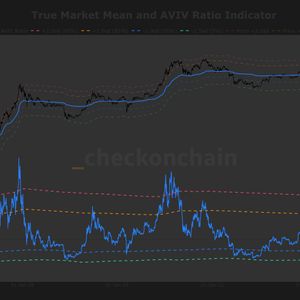
True Market Mean and Short-Term Holder cost basis form a critical $78.2K to $79.2K range that could define the next major move.
CoinDesk 2026-04-22 11:45